
In this guide
This guide focuses on the control points a business or advisor must get right. It does not try to replace the CRA’s registrant guide or cover every industry election and special rule. Use the source list below for current technical detail and the deadline tool for planning specific periods.
From guidance to operating record
Keep each GST/HST period connected to its evidence
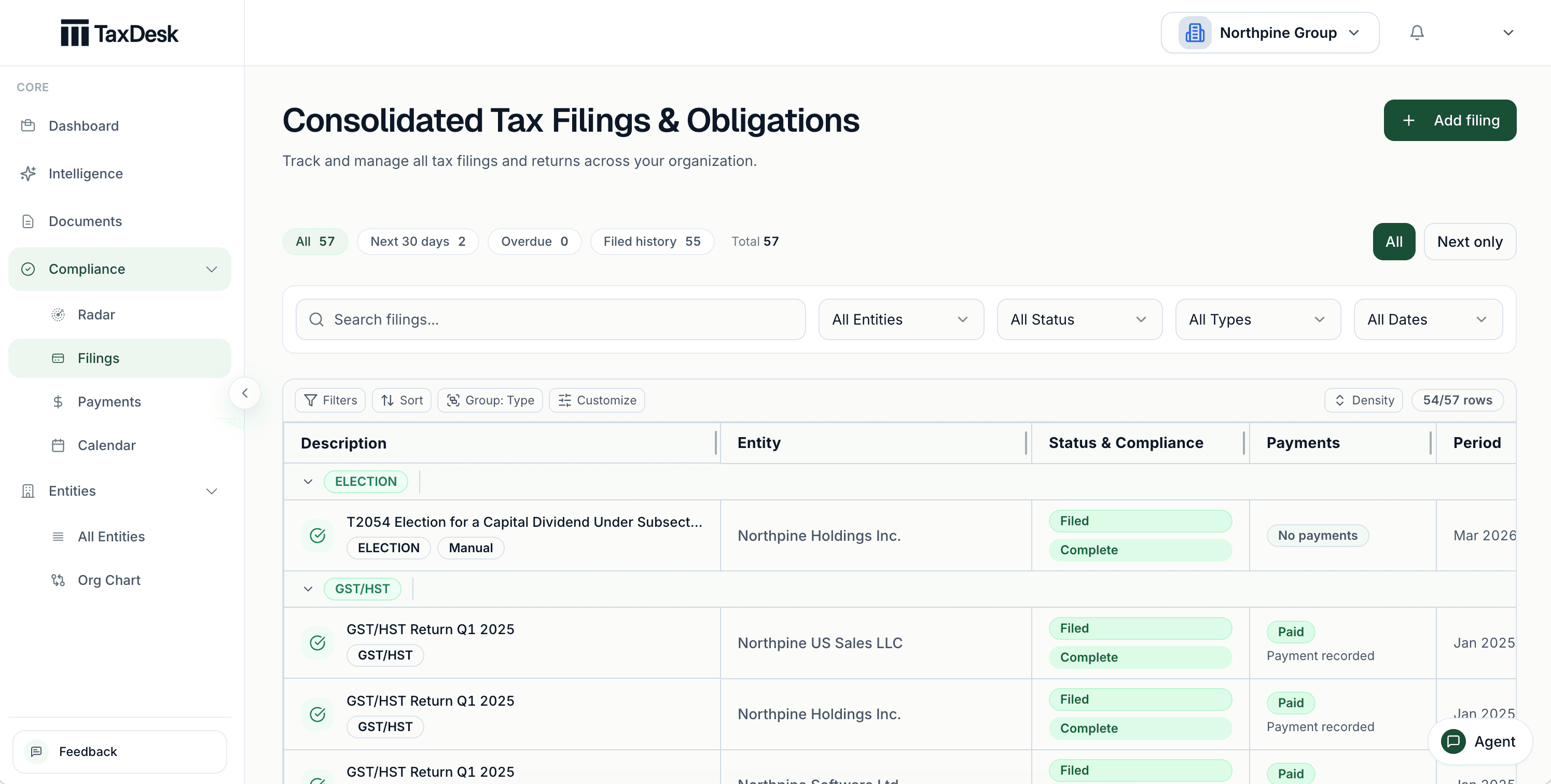
TaxDesk turns RT account settings into visible obligations and keeps returns, payments and supporting documents attached to the entity and period they belong to.
- RT account settings define reporting frequency and periods
- Each return and payment remains attached to the legal entity
- Evidence and status history stay visible during review
1. Registration begins with the legal person and its revenue
A person that makes taxable supplies in Canada in a commercial activity may need to register unless an exception applies. The ordinary small-supplier test generally looks at worldwide taxable supplies of the person and associated persons. For most businesses, the benchmark is $30,000 in a single calendar quarter or across the last four consecutive calendar quarters, with different rules for public service bodies and special categories.
Crossing the threshold is not just a year-end event. The timing and manner of crossing it affect when registration and collection begin. Voluntary registration can also create both the right to claim eligible input tax credits and the responsibility to charge, file and remit.
2. Determine what is being supplied before calculating tax
Supplies can be taxable at the applicable GST/HST rate, zero-rated, exempt or outside the scope of the ordinary rules. Those categories produce different collection and input-tax-credit outcomes. “No tax on the invoice” does not by itself tell you whether a supply is zero-rated or exempt.
3. The applicable rate follows place-of-supply rules
Headline provincial rates are only the last step. The business must first identify the type of supply and apply the relevant place-of-supply rule. Customer location, delivery destination, performance location and other facts can matter depending on what is sold.
Provincial sales taxes and Quebec sales tax are separate systems with their own registration and tax-base rules. A GST/HST conclusion should not be treated as a conclusion about PST, RST or QST.
4. Input tax credits are evidence-backed claims
A registrant may recover GST/HST paid or payable on purchases and expenses to the extent they support commercial activities, subject to the applicable rules. Eligibility is not determined by the expense label alone. Mixed use, reasonableness, recapture or restriction rules, accounting methods and timing can change the amount.
The documentary test matters just as much as the calculation. Before claiming an ITC, the business should have sufficient supplier, registration, date, description and tax information for the value of the supply.
5. Confirm the assigned reporting period—do not infer it
The CRA assigns annual, quarterly or monthly reporting periods based on taxable-supply revenue, and eligible registrants may be able to elect a more frequent period. The account’s actual setting is the control. Do not infer filing frequency from company size, last year’s folder structure or a generic threshold table.
Record the frequency, fiscal year-end, first open period and any election or change. When the account changes, preserve the prior periods rather than overwriting history.
6. Filing and payment need separate status
Registered businesses file a return for every reporting period, including nil periods when required. Monthly and quarterly returns are generally due one month after period-end. Most annual business filers generally file and pay three months after fiscal year-end, but important exceptions apply, including certain sole proprietors and listed financial institutions.
Most registrants are required to file electronically for periods ending in 2024 and later. Penalties and interest depend on the specific failure and amount outstanding, so a fixed “per month” shorthand should not replace the current CRA calculation.
7. Keep the records that make the return reproducible
The return summarizes tax collected, adjustments and ITCs. The complete file should let a reviewer trace those totals back to sales records, purchase invoices, import documents, credit notes, elections, working papers and the filed return. CRA guidance generally requires GST/HST records to be retained for six years, subject to exceptions and directions to retain them longer.
8. Review the chain, not just the net-tax number
A strong review starts with the entity and period, then checks registration, completeness of sales, classification of supplies, rate logic, ITC evidence, adjustments, filing status, payment status and the balance shown by CRA. This sequence catches errors a reasonableness check on the final balance cannot—especially wrong- entity invoices, missed nil returns, unsupported ITCs and payments applied to the wrong period.
Scope note. This guide is educational, not GST/HST advice. Registration, tax status, place of supply, input tax credit eligibility and deadlines can depend on detailed facts and elections. Confirm a specific treatment with current CRA guidance and a qualified advisor.
Primary reading
Official starting points used to develop and check this guide.
Continue the workflow
The next useful step
Put the guide into practice
Keep each GST/HST period connected to its evidence
TaxDesk turns RT account settings into visible obligations and keeps returns, payments and supporting documents attached to the entity and period they belong to.