
In this guide
This guide isn't going to teach you how to prepare a return — that's what your accountant, and a stack of CRA guides, are for. What it will do is lay out the full range of things a Canadian corporation can be on the hook for, so "compliance" stops meaning one form once a year and starts meaning the whole list. The rest of the site's guides go deep on individual pieces of this; this one is the map.
From guidance to operating record
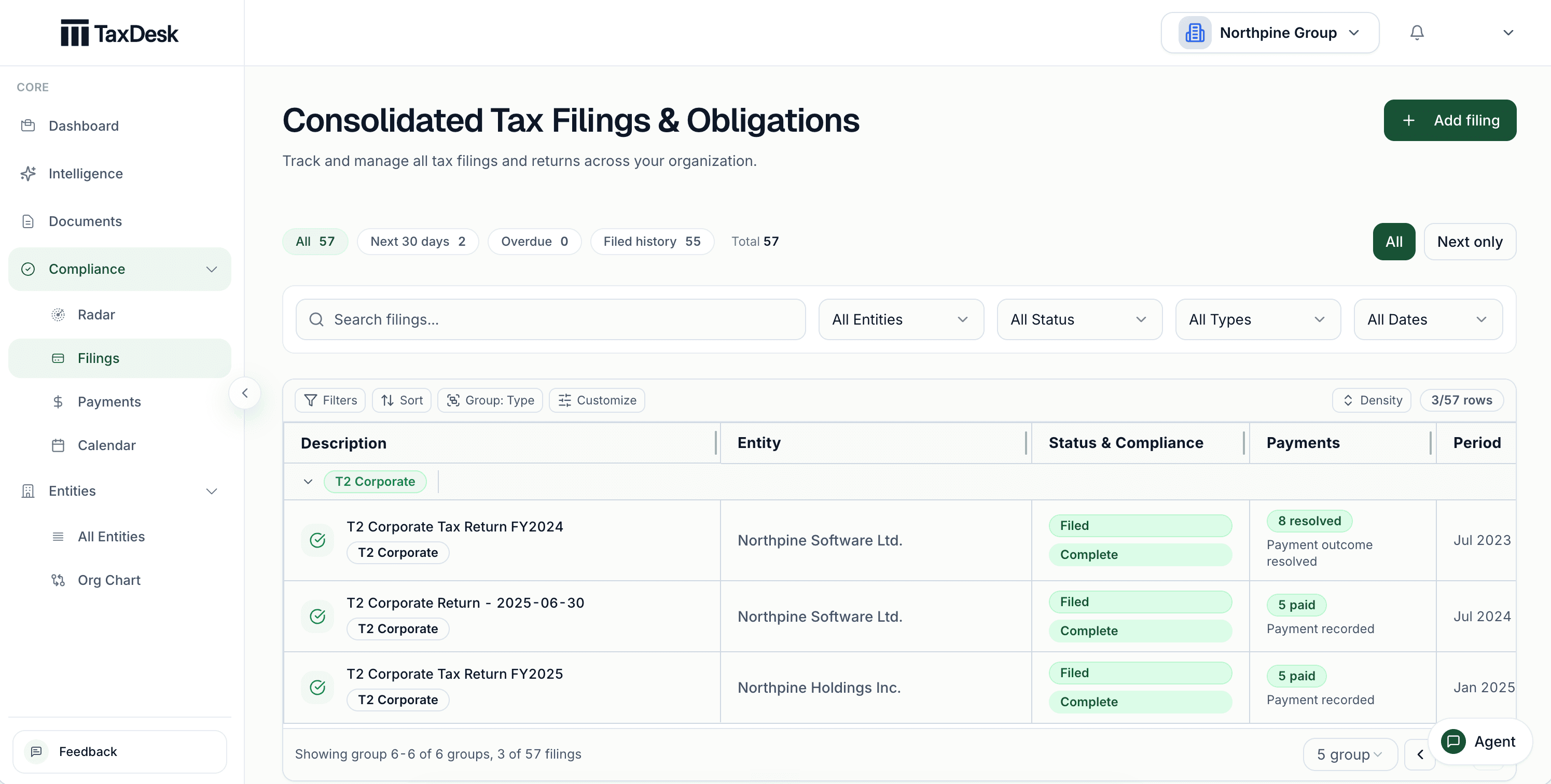
Keep every obligation in one place
TaxDesk tracks the filings, deadlines and documents behind your corporation—or your whole group—so nothing depends on someone remembering it.
- Obligations generated from tax-program settings
- Filing and payment work tracked with separate status and dates
- Source documents and action history kept with the obligation
1. What counts as a tax obligation
"Corporate tax obligation" covers more ground than most people assume. It isn't just the return itself — it's everything that comes with running a corporation inside the CRA's system:
A corporation with no tax owing can still be offside — a missed election, an unfiled slip, or a director address CRA doesn't have on file are all obligations too. None of them show up if you're only watching the balance owing.
2. What decides which obligations apply to you
No two corporations carry exactly the same list. What applies depends on facts about the business, and those facts change:
This is why a generic calendar — even a good one — only gets you so far. A holding company with no employees and a numbered subsidiary with a payroll account are governed by the same Income Tax Act, but the two lists of obligations barely overlap.
3. The main filings, organized by category
It helps to group these rather than treat them as one long list. Note the split at the end — tax filings and corporate-law filings run on separate tracks, but a business has to manage both at once.
- • T2 corporate income tax return
- • Balance owing
- • Corporate tax instalments
- • Applicable provincial filings
- • GST/HST returns
- • GST/HST remittances
- • Provincial sales tax, where it applies
- • Source deduction remittances
- • T4 slips and summary
- • T4A slips, where relevant
- • Records of employment
- • T5 (dividends and certain investment income)
- • NR4 (certain payments to non-residents)
- • Foreign reporting forms
- • Partnership or trust reporting, where applicable
- • Federal or provincial annual return
- • Beneficial ownership / individuals-with-significant-control record
- • Registered office and director updates
- • Share and ownership records
4. When things are actually due
Rather than list every possible date — that's what the deadline tool is for — it's more useful to understand the logic behind them. Corporate deadlines are driven by one of a few patterns:
- • Tied to the fiscal year-end (T2 filing and payment)
- • Tied to a reporting frequency (monthly, quarterly or annual GST/HST and payroll)
- • Fixed to the calendar year regardless of fiscal year-end (T4, T5, NR4)
- • Triggered by an event rather than a schedule (see the next section)
- • Stated directly in a CRA notice, which overrides the general rule
| Obligation | What triggers it | Typical timing |
|---|---|---|
| T2 return | Corporation has a tax year | After each fiscal year-end |
| Corporate tax balance | Tax payable | Usually ahead of the T2 filing deadline |
| Instalments | Sufficient tax payable | Monthly or quarterly |
| GST/HST return | Registered for GST/HST | Monthly, quarterly or annually |
| Payroll remittance | Employees and source deductions | Set by remitter type |
| T4 return | Employment remuneration paid | Annually, calendar year |
| T5 return | Certain investment income or dividends paid | Annually, calendar year |
| NR4 return | Certain payments to non-residents | Annually, calendar year |
| Corporate annual return | Incorporated entity | Annually, jurisdiction of incorporation |
This table shows the logic, not exact dates — confirm current deadlines for your specific entity with your accountant or the CRA before relying on them.
5. Obligations triggered by events, not the calendar
This is probably the most overlooked part of corporate compliance, because it doesn't happen once a year — it happens whenever the business does something. A few examples:
Tax obligations don't only show up at year-end. They get created by whatever the company actually does, and most of these events happen months before anyone's thinking about the next T2.
6. What CRA notices actually mean
A letter from the CRA isn't automatically bad news — most of what shows up is routine. Here's roughly what you're looking at when something lands:
In every case, the first useful question is the same: which entity, and which period, does this belong to? Groups with more than one corporation lose more time here than anywhere else.
7. What CRA tends to look at closely
This isn't a list of "audit triggers" — plenty of legitimate businesses touch every item on it. It's just where CRA's attention tends to land:
- Revenue completeness
- Expense and deduction support
- GST/HST collected and ITCs claimed
- Payroll and contractor classification
- Shareholder benefits and shareholder loans
- Related-party and intercompany transactions
- Dividends and corporate tax accounts
- Capital transactions
- Foreign transactions and reporting
- Reorganizations and unusual transactions
- Gaps between filings and third-party information
Note what most of these have in common: it's rarely just about whether the tax treatment was correct. It's about whether the corporation can actually produce something that backs it up. Correct and undocumented tends to go about as well as incorrect.
8. The records behind all of this
Every obligation above eventually needs something to point to. In practice that's some combination of:
9. What happens when it isn't tracked
None of this is theoretical — it's the same handful of problems, over and over, once obligations stop being tracked properly:
- • Missed filings, followed by interest and penalties
- • Duplicate or contradictory filings across entities
- • Elections that quietly lapse because no one tracked the deadline
- • CRA notices that sit unanswered
- • Nobody quite agreeing what the current balance actually is
- • Director exposure in certain circumstances
- • A rough handoff whenever advisors change
- • Problems surfacing during financing, a sale, or due diligence
- • Rebuilding years of history from scratch when it finally matters
10. Where TaxDesk fits in
TaxDesk keeps a structured record of the entities, accounts, obligations, documents and deadlines in a corporate group — instead of a spreadsheet here, a shared calendar there, and a folder of NOAs somewhere else. It doesn't file anything on your behalf; it's a system of record for what applies, what's due, what's been filed, and what backs it up.
Scope note. This guide is educational, not tax advice. Obligations, rates and deadlines vary by entity and change over time — confirm anything specific to your corporation with a qualified advisor or directly with the CRA before acting on it.
Primary reading
Official starting points used to develop and check this guide.
Continue the workflow
The next useful step
Put the guide into practice
Keep every obligation in one place
TaxDesk tracks the filings, deadlines and documents behind your corporation—or your whole group—so nothing depends on someone remembering it.