
Tax operations for Canadian finance teams
 Tax operations for Canadian finance teams
Every company. One tax workspace.
Tax sits with your finance team. Keep every entity, filing, payment, CRA document, and tax balance in one place, while your external advisors handle the technical work.
The system you have now
More companies shouldn’t mean more spreadsheets.
Your accountant prepares the returns. As controller or finance lead, you still coordinate deadlines, payments, CRA notices, and the documents they need. Give that work a home beyond Outlook, SharePoint, and last year’s tax folder.
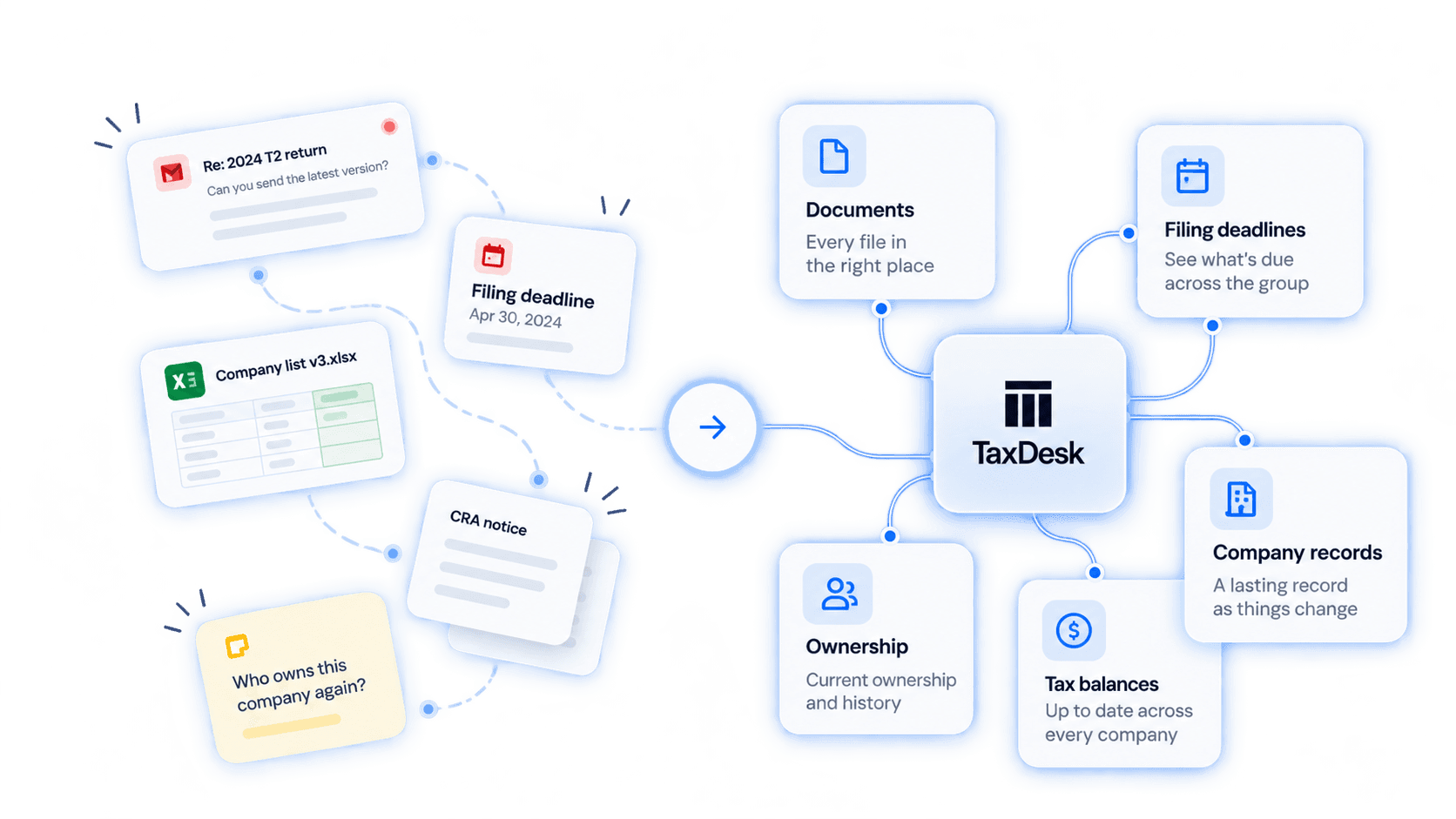
Scattered information
Filing control
Know what’s due. Across the whole group.
Record each company’s tax programs and filing schedule. TaxDesk then creates a clear list of filings and payments. Each item includes its due date, status, history, and supporting documents.
- Corporate tax, GST/HST, payroll, and more
- Upcoming and overdue work in one view
- A clear record of filing status and supporting evidence
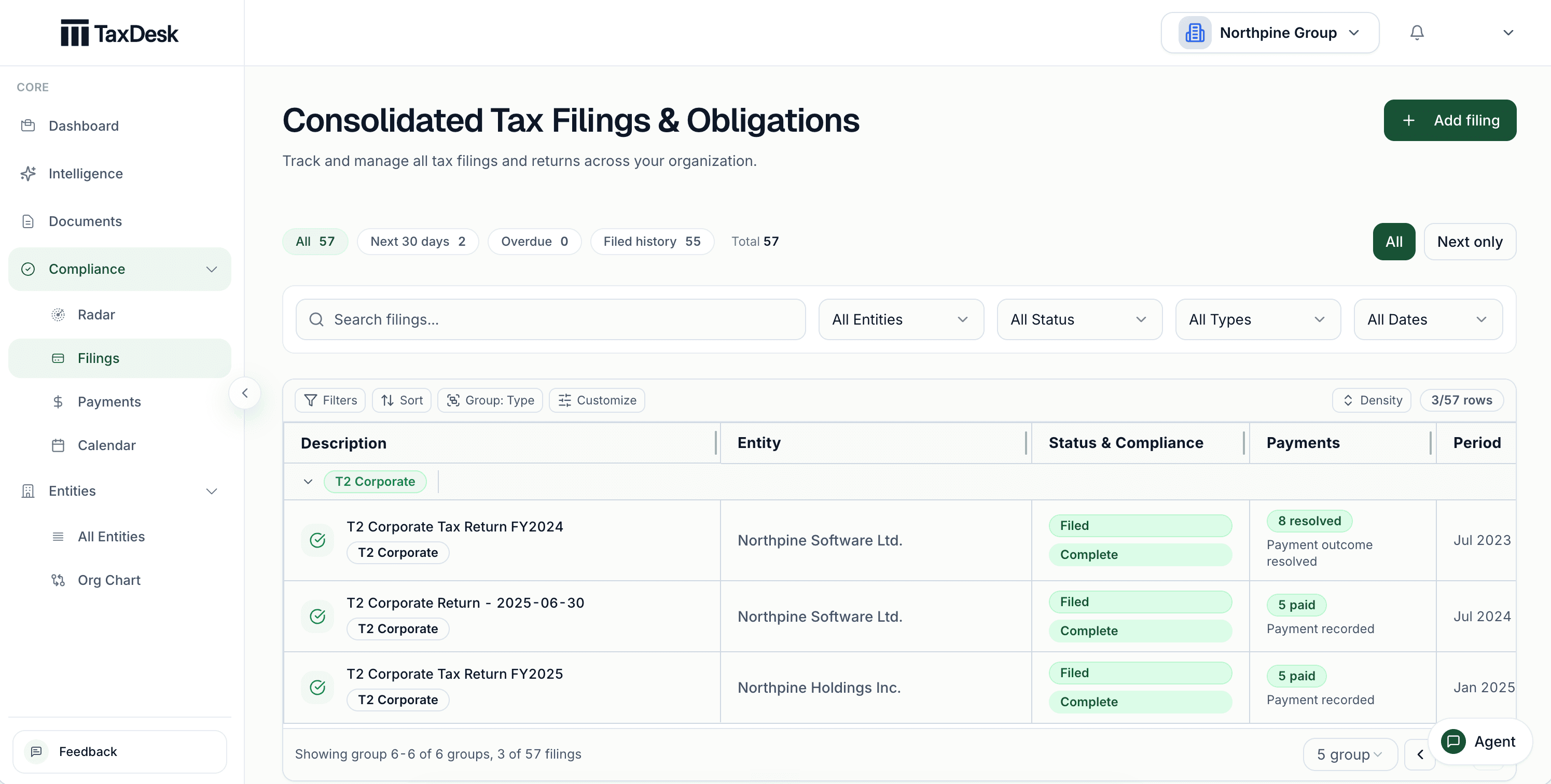
- 1Upcoming and overdue work, counted at a glance
- 2Every filing grouped under its entity
- 3Each filing carries its own status
- 4Payments tracked beside each filing
Documents
Your tax documents. Put to work.
Upload returns, financial statements, CRA notices, agreements, and working papers. TaxDesk reads each one and links every fact to the page it came from. When a document disagrees with your records, your team decides.
- The right company and tax year attached
- Every fact linked to its source page
- Conflicts wait for your team’s decision
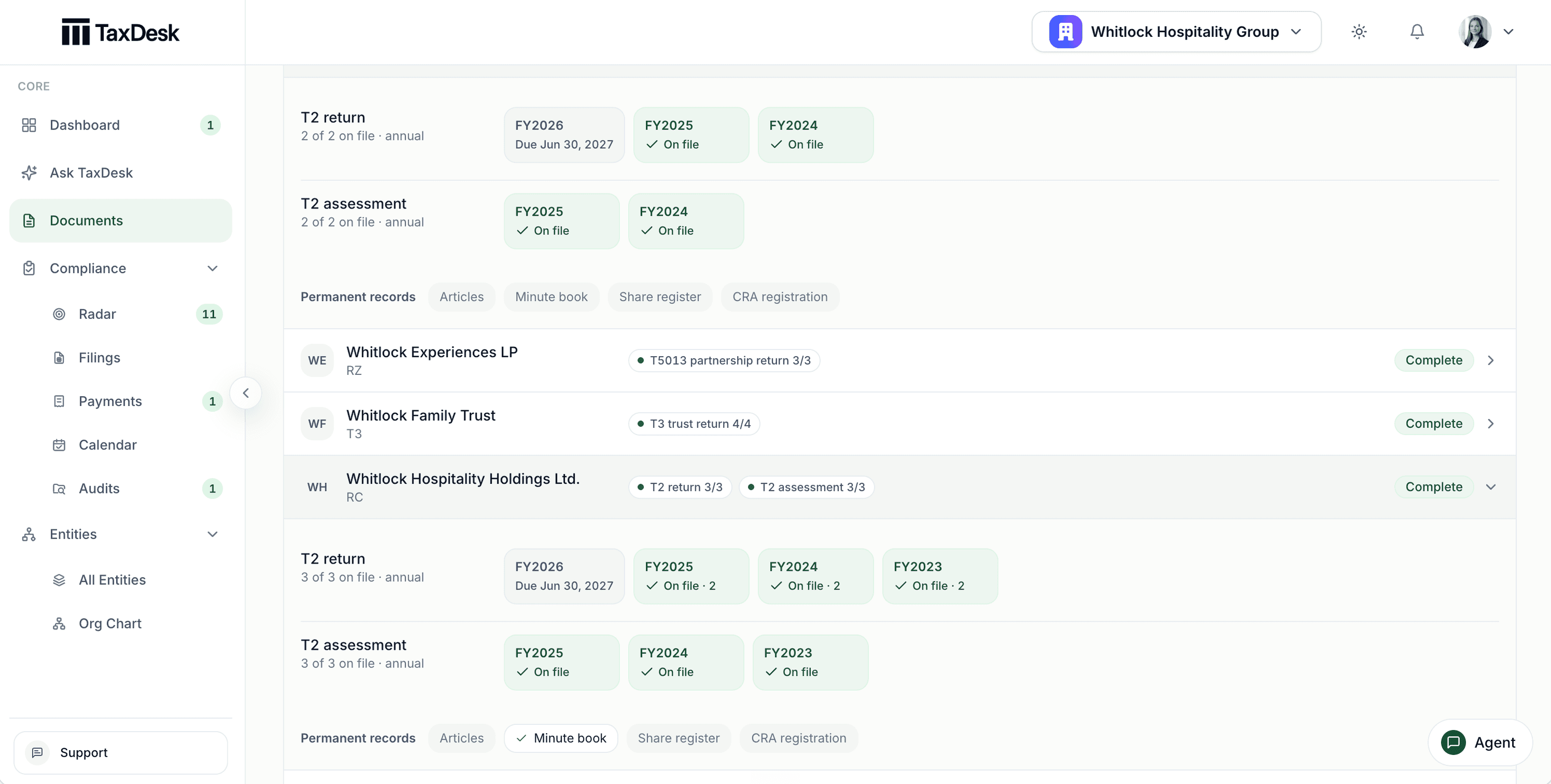
- 1Partnerships and trusts get their own schedule: T5013 and T3
- 2Each period shows what is on file and what is due next
- 3Returns and assessments filed to the right year
- 4Permanent records tracked separately
TaxDesk Agent
See what matters, with the evidence beside it.
Ask the TaxDesk Agent what needs attention across the group. It answers from your workspace records, and Compliance Radar keeps the overdue and upcoming work ordered by urgency.
- What’s overdue and due next, across every company
- Answers grounded in your own records
- Ask in plain language
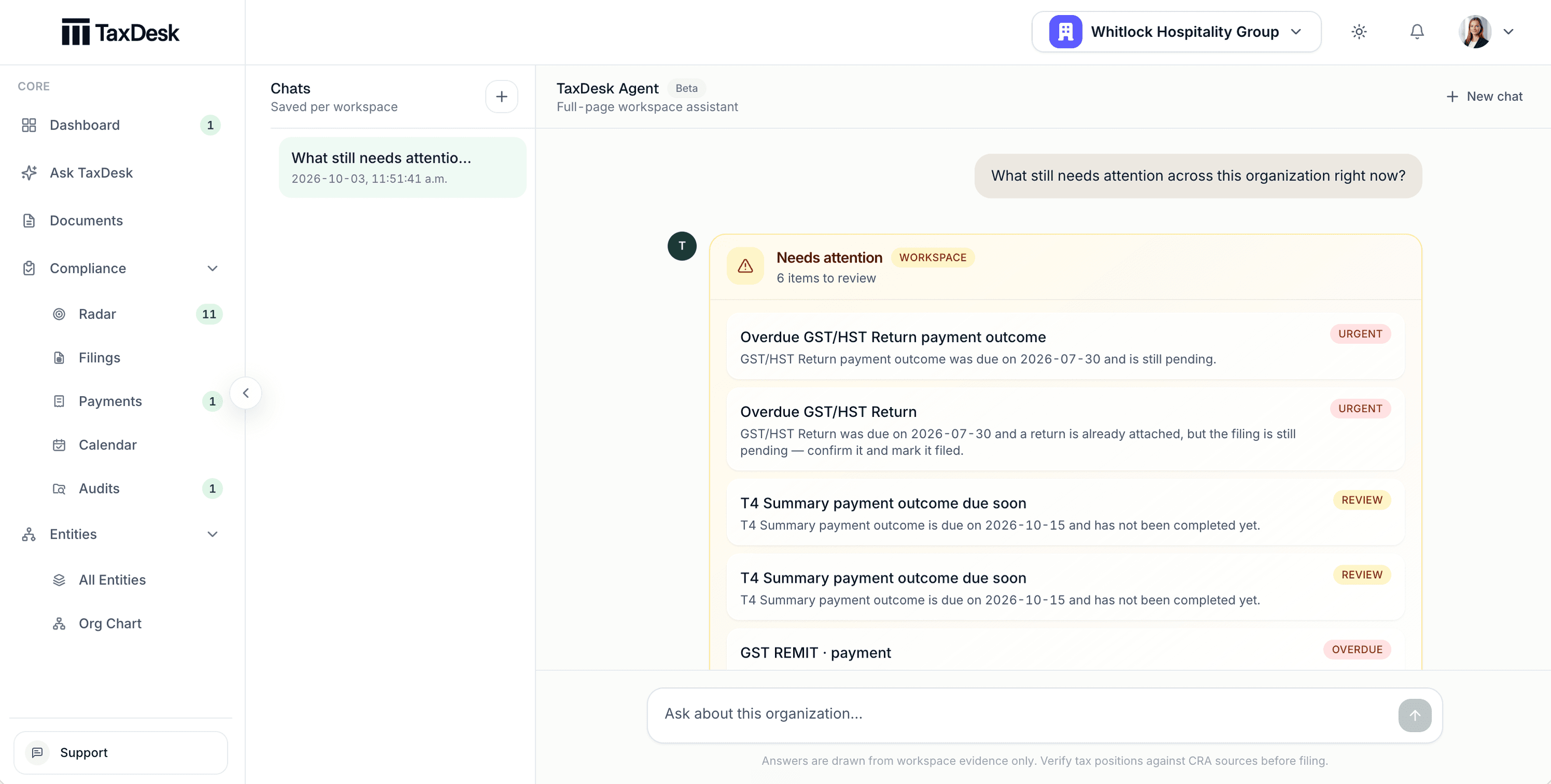
- 1Ask in plain language
- 2A summary of what needs attention across the workspace
- 3Items marked urgent, review, or overdue, each with its due date
Why TaxDesk
Keep precise Canadian tax records without piecing them together.
- 01
Everything stays together
Keep companies, filings, documents, and important tax details together in one workspace.
- 02
TaxDesk suggests. Your team decides.
When a document disagrees with your records, nothing changes without review.
- 03
Your tax data stays private to your organization.
TaxDesk keeps your organization’s records separate from other customers’ records.
AI agents
Run TaxDesk from the agent you already use.
Connect your assistant to TaxDesk. It can read the live workspace and keep it up to date: filings, payments, tax balances, and CRA reviews. TaxDesk remains the record, with the source documents and a history of every change.
- 01
Claude, ChatGPT, Codex, or Microsoft Copilot
- 02
Within your TaxDesk permissions
- 03
Every change logged and reversible
Illustrative example · sample workspace data
Who TaxDesk is for
Give every person who manages complex Canadian tax work the same record.
Stay on top of tax without a tax department.
For controllers, Directors of Finance, VPs of Finance, and CFOs coordinating tax across several Canadian entities. Own the record and keep your existing CPA and tax counsel.
TaxDesk for finance teamsA consistent structure across every client workspace.
Give each client group the same structure. Work across only the client workspaces your firm can access.
TaxDesk for CPA firmsTaxDesk resource library
Practical guidance for the Canadian tax work your team manages.
Browse all resourcesNot sure TaxDesk fits?Ask the assistant you already use to read our pages and give you a candid answer.


If the prompt does not appear in your assistant, paste it from your clipboard. Gemini opens a new chat for you to paste it into.
Help me decide whether TaxDesk fits my work. Read https://www.taxdesk.ca/, https://www.taxdesk.ca/features, https://www.taxdesk.ca/pricing and https://www.taxdesk.ca/llms.txt directly rather than relying on search snippets or memory; if you can't open them, tell me. Then, based on what you already know about me and my work, give me a candid read: where TaxDesk would help, where it wouldn't, and what I should verify before deciding. Ask me only what you don't already know and genuinely need, in at most three short questions. Cite the page behind each product claim and say when something is unknown. You can't see my private TaxDesk workspace or tax records.