
In this guide
Every step in this guide is a version of something that works fine for a single corporation but breaks once there's more than one — a calendar that only has one entity's deadlines, a folder that doesn't say which company a document belongs to, a CRA letter that gets opened without anyone checking which entity it's actually addressed to. None of these are hard problems. They're just easy to miss until the group has grown past the point where memory covers the gaps.
From guidance to operating record
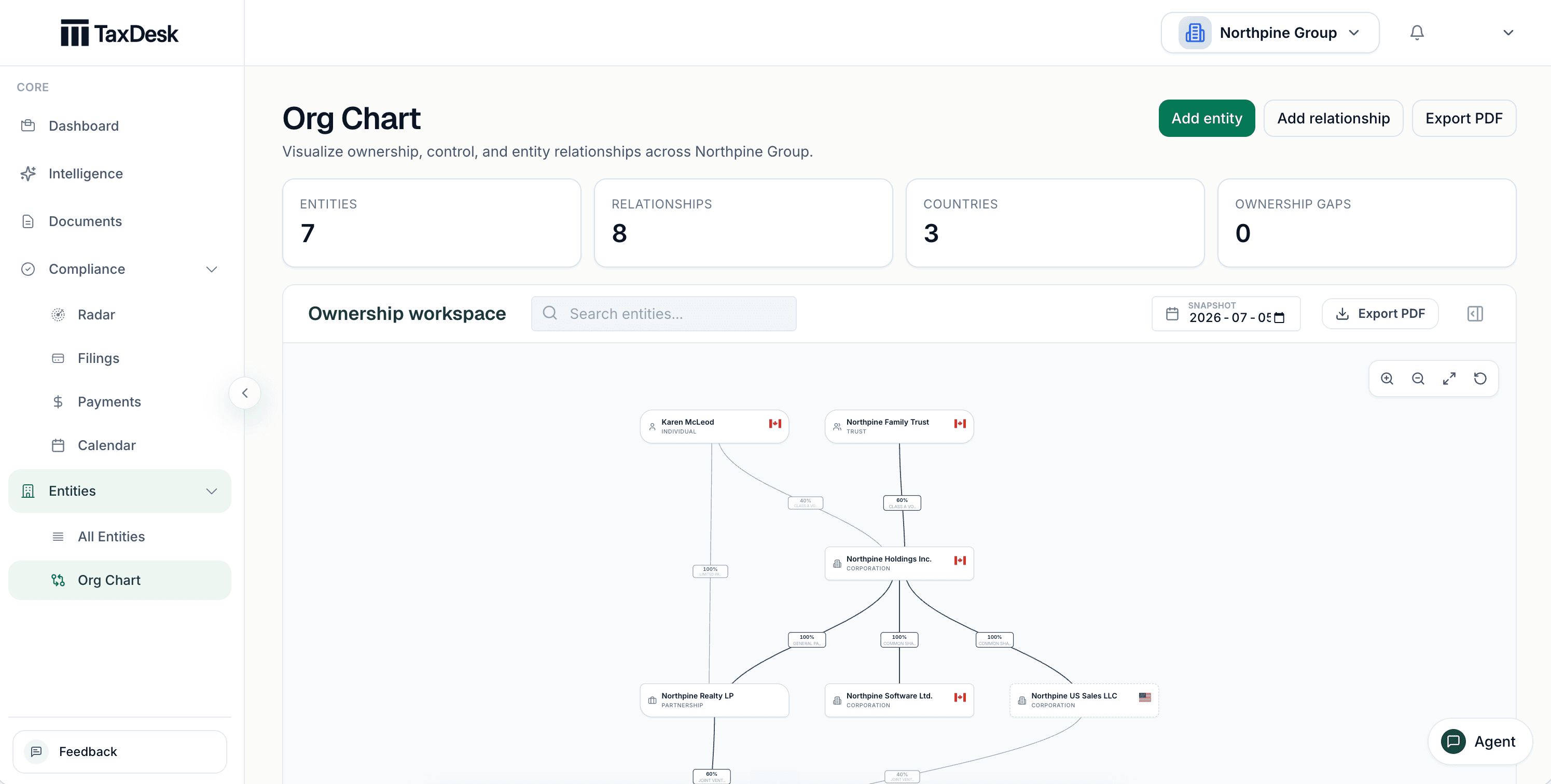
One workspace, every entity in the group
TaxDesk tracks obligations, documents and balances per entity while keeping the group visible as a whole — so nothing depends on remembering which company a given deadline belongs to.
- Group-wide visibility without collapsing distinct entity records
- Ownership relationships generated from structured data
- Obligations and evidence remain attached to the correct entity
1. Start with an entity inventory
The unglamorous first step, and the one most groups skip: a complete list of every corporation, partnership and trust in the structure, including the ones that are dormant or barely used. It's common for a group to have an old numbered company sitting around that nobody's thought about in years — until a CRA letter shows up addressed to it.
For each entity, the inventory should note incorporation jurisdiction, fiscal year-end, and current status (active, inactive, being wound up). This becomes the backbone everything else in this guide attaches to.
2. Map the ownership structure
Who owns what, by percentage and by share class, and how that's changed over time. This matters for more than a nice org chart — it determines associated-corporation status, how the small business deduction limit gets shared, and how dividends flow through the group. See why ownership and share-class records matter for tax for the detail behind this step.
3. Track CRA tax programs per entity
Each entity has its own tax-program registrations—RC for corporate income tax, RT for GST/HST, RP for payroll, and others depending on activity. It's normal for related entities to have different accounts open: the holdco might have no RP account at all if it has no employees, while the opco has all four. Tracking which accounts exist per entity avoids the common mistake of assuming every entity in the group has the same obligations.
4. Build one filing calendar, not several
Every entity has its own deadlines, but they need to live in one place to be useful — a separate calendar per entity just recreates the tracking problem at a different scale. A shared calendar that shows which entity each deadline belongs to lets a controller or CPA firm see the whole group's filing load at once, instead of checking four different sources to find out what's due this week.
6. Intercompany balances
Loans, management fees and cost-sharing arrangements between related entities need to reconcile — what one entity's books show as a payable should match what the other shows as a receivable. In practice these drift apart quietly over a few years unless someone reconciles them on a schedule. See shareholder and intercompany loans in Canada.
7. Dividends and payments between entities
Dividends flowing up through a holding structure, management fees flowing down, and any other payments between related entities all need to be tracked against the tax attributes they draw on or contribute to — a capital dividend needs a CDA balance to support it, an eligible dividend needs GRIP. Keeping a record of what's been paid, from which entity, against which balance, is what makes the numbers on next year's return defensible.
8. Routing CRA correspondence to the right entity
A letter that mentions "your corporation" is easy to misfile in a group with several similarly-named entities. Every piece of CRA correspondence should be logged against the specific entity and program account it relates to as soon as it arrives — not weeks later when someone's trying to remember which numbered company it was about.
9. Consistent document organization
The entity / period / document-type structure from what belongs in a corporation's tax file matters even more here, because it's the only thing that lets someone search across the whole group consistently rather than learning a different filing convention for every entity.
10. Responsibility and review status
Groups with an internal controller and an external CPA firm both touching the same entities need clarity on who's responsible for what — who prepares, who reviews, who files. Without that recorded somewhere, the default assumption tends to be "someone else is handling it," which is how filings get missed even when everyone involved is competent.
11. Preserving historical changes
Ownership changes, amalgamations, wind-ups and fiscal year-end changes all need to be preserved as history, not just reflected in the current state. Three years from now, someone will need to know what the structure looked like at a specific point in the past — during a sale, a financing round, or simply explaining a prior year's return to a new advisor.
Scope note. This guide covers operational organization, not legal or tax structuring advice. Group structures, associated-corporation status and intercompany arrangements should be reviewed with a qualified advisor.
Primary reading
Official starting points used to develop and check this guide.
Continue the workflow
The next useful step
Put the guide into practice
One workspace, every entity in the group
TaxDesk tracks obligations, documents and balances per entity while keeping the group visible as a whole — so nothing depends on remembering which company a given deadline belongs to.